
The Louisa County Owner Record
The assessment roll is the fastest public source for the owner of record on a Louisa County parcel. It serves tax administration first. The county confirms what its search can connect. Field labels vary by result card. Open the live record to see the fields for a particular property.
| Owner name | Copy the assessment owner spelling as displayed. |
|---|---|
| Situs address | Physical location used to identify the parcel. |
| Mailing address | Where tax correspondence is sent, which may differ. |
| Map and parcel | Cross-office key for GIS and the clerk index. |
| Assessment value | Annual value used for tax administration. |
| Property traits | County says traits are analyzed; exact displayed fields are not confirmed. |
An owner label on the tax roll is not a deed image. Note the parcel ID and the date you pulled the roll.
Search a Louisa Current Owner
Enter one detail at a time in Louisa's assessment search. A name or an address works. If you know both, run separate searches. County GIS also supports searching by parcel ID, address, or owner, and using the same parcel key across both systems keeps a same-name result from pointing at the wrong property. Spell the owner exactly as the deed does, including any company suffix or estate name.
A name search can return several parcels. Narrow it with situs, map number, or legal description. Result fields vary on the live card, so open the record to see what each search returns. The official assessment search is Louisa Assessments.
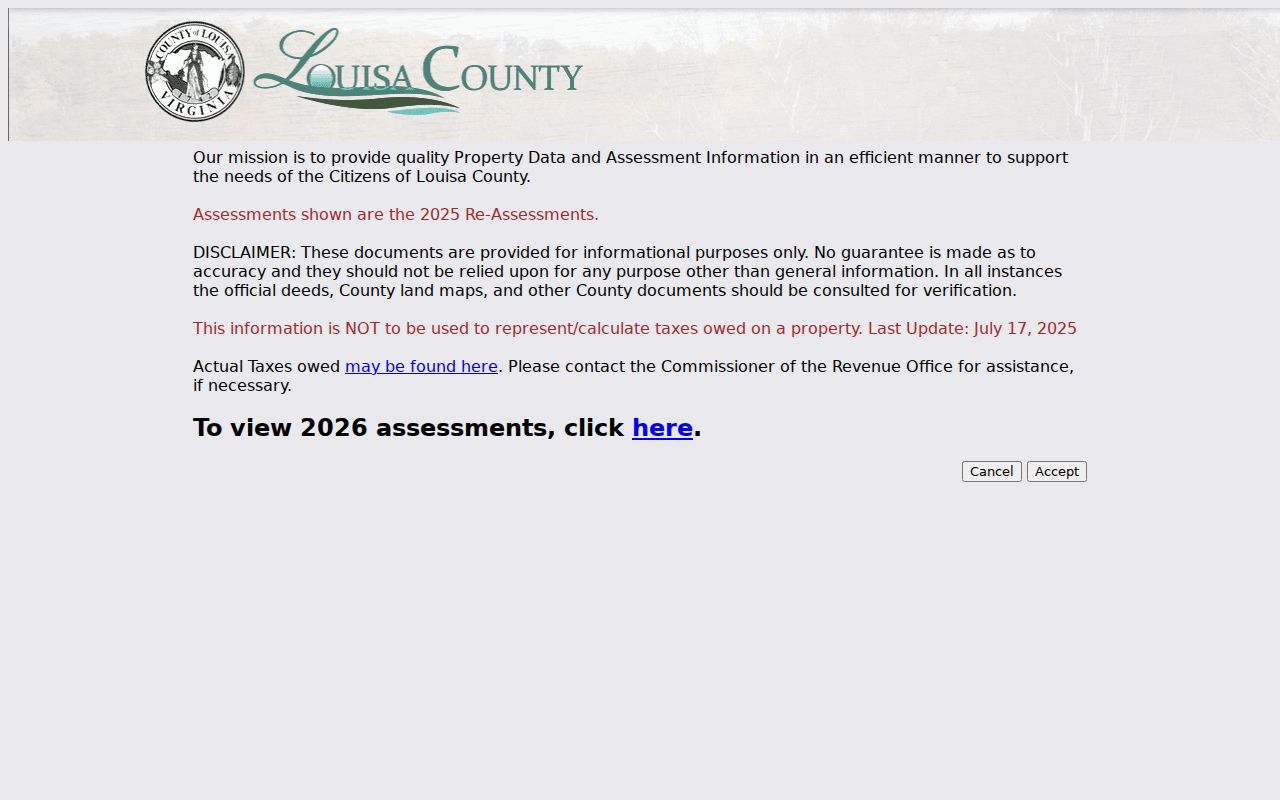
This capture shows the search entry page, not a parcel-specific current owner card.
How Current Is the Louisa Roll
Louisa assesses real estate as of January 1 and updates values annually, while physical review follows a five-year rotation. A recently signed deed may therefore be newer than the annual value record or may not yet be reflected in the name a user sees. For a billing-address change or a question about the tax account, the county lists 540-967-3432; for valuation or parcel-card questions, call the Commissioner of Revenue at 540-967-3450. Confirm the recorded instrument with the clerk when timing matters.
The assessment office transfers property based on deeds or wills recorded with the Circuit Court clerk. A recorded deed may therefore precede a visible assessment update. The research did not find a published service standard or typical number of days between those events. Check the dates on the latest deed and the assessment result for the parcel rather than assuming the roll updates on a set schedule.
Louisa assessments are made annually as of January 1. The assessment page says real estate is reassessed each year, and the county FAQ describes annual analysis and a five-year physical rotation. These details describe value work, not a guarantee about when every owner field changes after a transfer.
For owner-address or tax changes, Louisa lists 540-967-3432. Assessment questions go to 540-967-3450.
Louisa Situs and Mailing Address
Situs and mailing fields carry different jobs. The situs points to the land itself. The mailing address is where the bill or notice goes. It may be a post office box, a lender, a business, or an out-of-county address belonging to the owner of record. A bill sent to a prior address does not change the deed, and an address correction does not prove title transferred. Keep a dated copy of the deed recording reference, and ask which office updates each field.
Louisa County includes rural route-based addresses. A mailing city like Louisa or Mineral can also stretch past the town boundary. Postal labels follow carrier routes, not municipal lines. Check the county GIS map for the physical parcel and the town line. Compare the town zoning map when local rules matter. The billing address is not an occupancy record.
Road names and mailing labels change over time. The parcel key survives both. Preserve the full parcel number and legal description whenever an address label shifts. That key links the current assessment to the recorded deed.
Confirm the Louisa Owner by Deed
A name on the tax roll is a starting point. Want to confirm who actually holds title in Louisa County? Pull the newest recorded deed and read the grantee line. Compare that name against the assessment record for the same parcel. Cott eSearch and Virginia SRA both let you search by party name. Note the instrument reference, the recording date, and the legal description before going further.
An index entry alone proves the document exists. Its terms live in the image or a clerk copy. Cott offers guest and account access plus a Certified Dates utility. The public landing page does not state an earliest index year for Louisa. Virginia SRA images require local clerk authorization and a signed agreement. Some courts open index-only access free. When a remote search misses the deed you need, visit a courthouse terminal or call Louisa Circuit Court at 540-967-5312.
For the wider picture, the Louisa County owner-finding method shows how assessment, parcel, and deed checks work together.
Survivorship and Louisa Owner Names
Louisa County has a set path for removing a survivorship name from the roll. The Real Estate Assessment office asks for two items. One is the original deed showing the right of survivorship. The other is a death certificate. Both go to the Commissioner of Revenue. Other name changes go through a Circuit Court clerk filing instead. That step is administrative. It does not mean every deceased owner transfer looks the same in the tax records.
Deeds in Louisa County can name a person, an LLC, a trust, or an estate. Copy the party name exactly as recorded. A will alone never completes a title transfer. The transfer may rest on a probate order, a deed of distribution, or a survivorship filing. The office can explain which record a current account change needs.
Death certificates are not open property records. Virginia vital records carry their own eligibility rules and access limits. Direct certificate questions to the Virginia Department of Health rather than to the county recorder.
PropertyCheck for Current Owners
PropertyCheck gives Louisa County owners a free alert service. The Circuit Court Clerk announced it on September 17, 2024. It was created as a way to receive notice when a filing matches a subscribed name. The signup uses the owner name exactly as it appears in the official record. The subscriber picks a notification method. The name printed on the deed or the assessment roll is therefore the name to enter. Enter it exactly that way when setting up the alert.
Treat any alert as a prompt, not a verdict. Note the date and the matched instrument reference. Then pull the actual document from the clerk's index before drawing conclusions. A notice does not decide that ownership changed. It also does not promise that every filing will trigger one. PropertyCheck is not a title search. If a fee request follows an alert, verify it through the official Cott index or by calling the clerk first.
The clerk-linked PropertyCheck page is the official alert route.
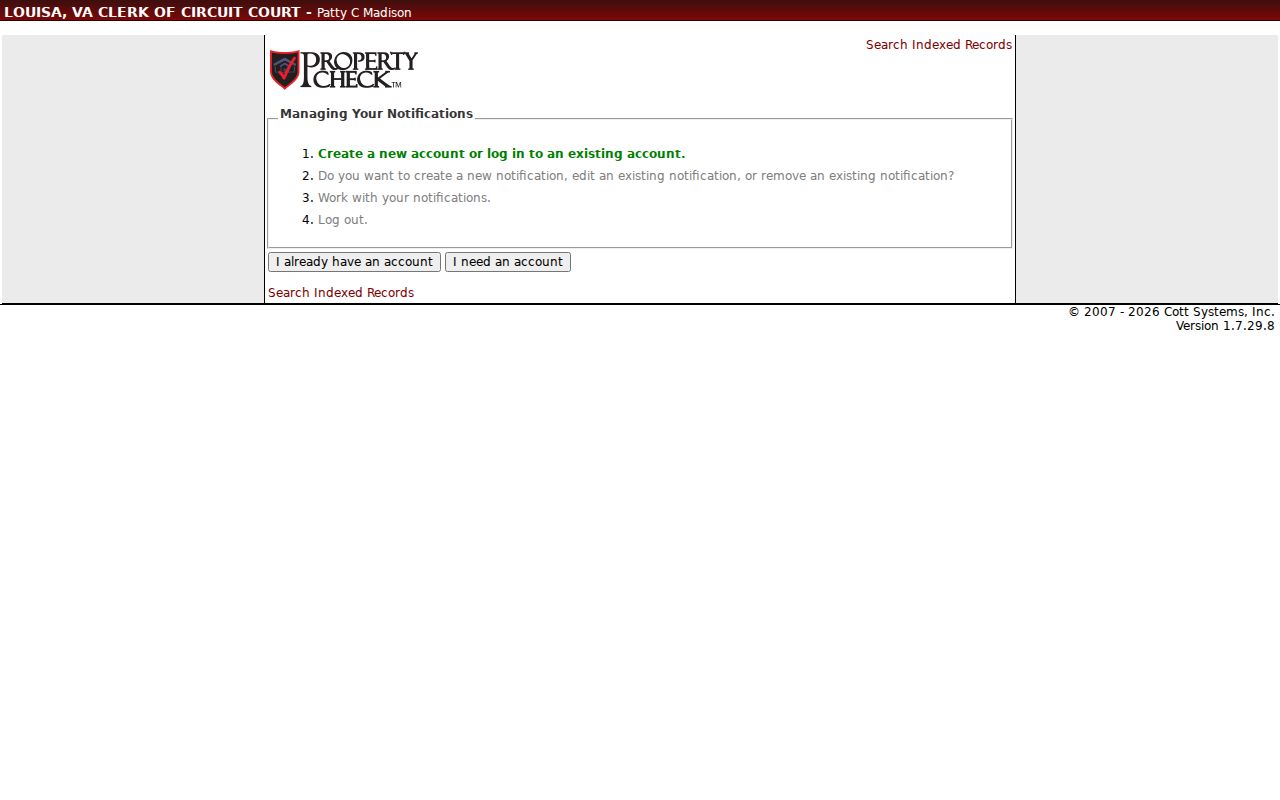
Use the service as a notice tool, then confirm a matched filing with the recorded document itself.
Limits of a Louisa Owner Check
A Louisa County assessment name is an owner-of-record lead for tax administration. It is not proof of title, a full chain, or a boundary line. Mailing and situs addresses can differ. A recorded deed transfer can be newer than the current tax roll. An entity name on the parcel also hides the private people behind it. Virginia's Address Confidentiality Program adds one more wrinkle, since protected participants may use substitute addresses.
When the present owner matters for a purchase or an estate, verify the latest recorded deed. Consult a title professional as needed. A name or mailing address should never be used to follow or target anyone.
Verify the instrument. The latest recorded Louisa County deed is the better source for a recent conveyance; the assessment roll may not yet reflect it.