
What Louisa County Tax Records Show
Louisa County keeps two main tax records. The assessment roll sets each parcel's annual taxable value. The Treasurer's bill follows the account itself, tracking the payments made and any balance left. A taxpayer name may appear on the billing, but only the deed records the conveyance of ownership.
| Record or field | What it can show | Where to look |
|---|---|---|
| Assessment owner field | Name carried for tax administration | Louisa Assessments |
| Assessed value | Annual parcel value used in the tax process | Commissioner of Revenue |
| Ticket Number | Tax bill account reference | Printed bill and Treasurer payment route |
| Property I.D. Number | Parcel-linked payment identifier | Printed bill and online payment |
| Balance and status | Payment record for the account | Louisa County Treasurer |
Exact field labels vary by screen and by year. Match the visible ticket number and property identifier carefully, and call the Treasurer if the identifiers on a document do not line up.
January Assessment in Louisa County
Louisa County puts a January 1 date on every real-estate assessment. It revisits values each year. Virginia law requires assessments at fair market value. Behind the numbers sits the Commissioner of the Revenue. That office maintains parcel records, assigns tax map numbers, and updates owner addresses whenever assessment changes flow into billing. It also produces the annual real-estate land book. The Treasurer relies on that book to issue each tax bill.
How does the county keep values honest? A five-year physical rotation runs alongside annual analysis and state sales-ratio checks. The rotation is a method, not a guarantee that an appraiser walks every driveway annually. Louisa County says square footage, home type, year built, quality, condition, bedrooms, baths, acreage, and location all factor into valuation. Still, the public assessment result may not display each item.
The Louisa County Real Estate Assessment information page posts the annual assessment date and office contacts.
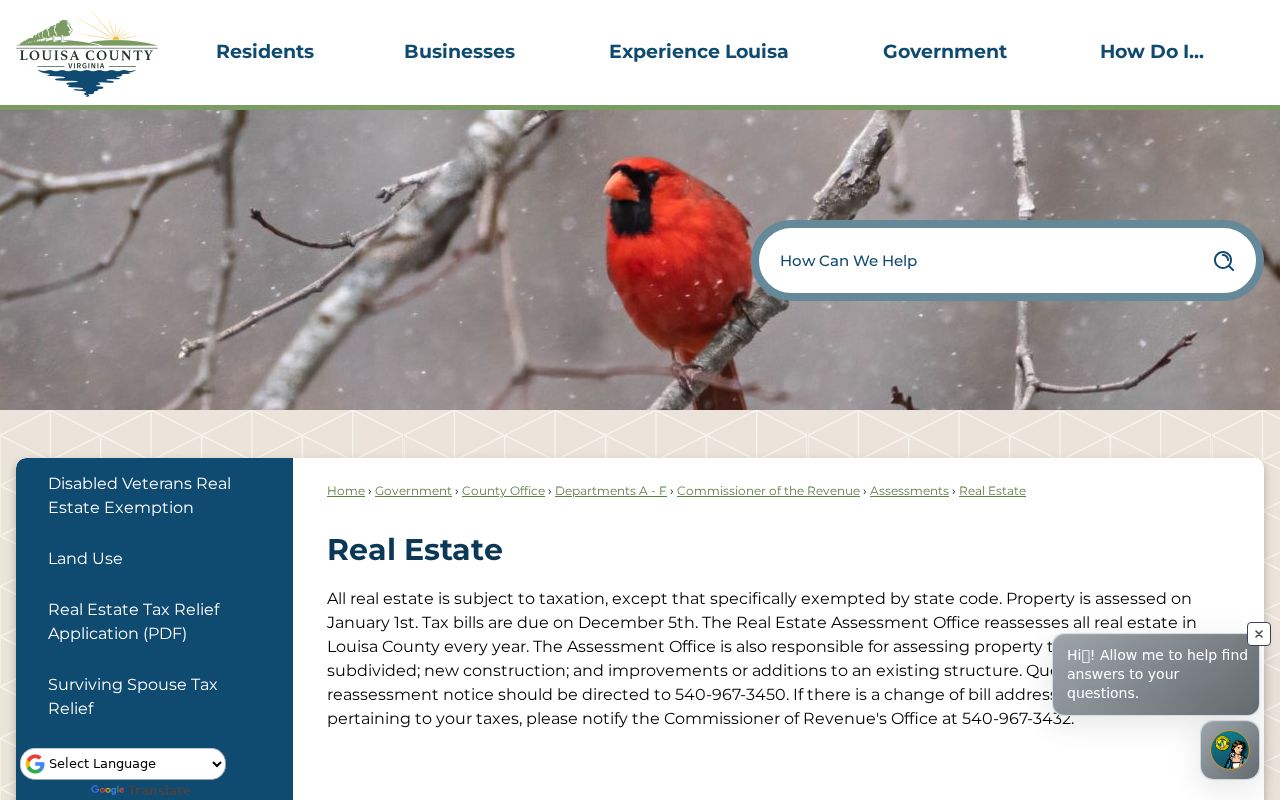
The county page connects parcel assessment, owner-address updates, tax relief and appeals.
Assessment Value and Tax Charge
Think of assessed value as the parcel's tax value. County and state rules set it. The bill also reflects the applicable rate, any relief or credits, and the account status. Market value does not set the charge. Nor does a bill establish legal title.
The 2025 real-estate tax notice referenced a rate of 72 cents per 100 dollars of assessed value. A 3.3 percent rebate applied automatically to 2025 bills. Treat that as a dated policy notice, since a later bill may differ; check the current year's official Treasurer notice before calculating an amount.
Virginia Tax's 2024 ratio study covered 700 Louisa sales. The median assessment-to-sales ratio came in at 86.00 percent, with a 16.75 percent coefficient of dispersion and a 1.01 regression index. Those are locality-level quality measures. They gauge appraisal consistency countywide, not the price one parcel might fetch. The assessment FAQ explains the county method and its ratio checks.
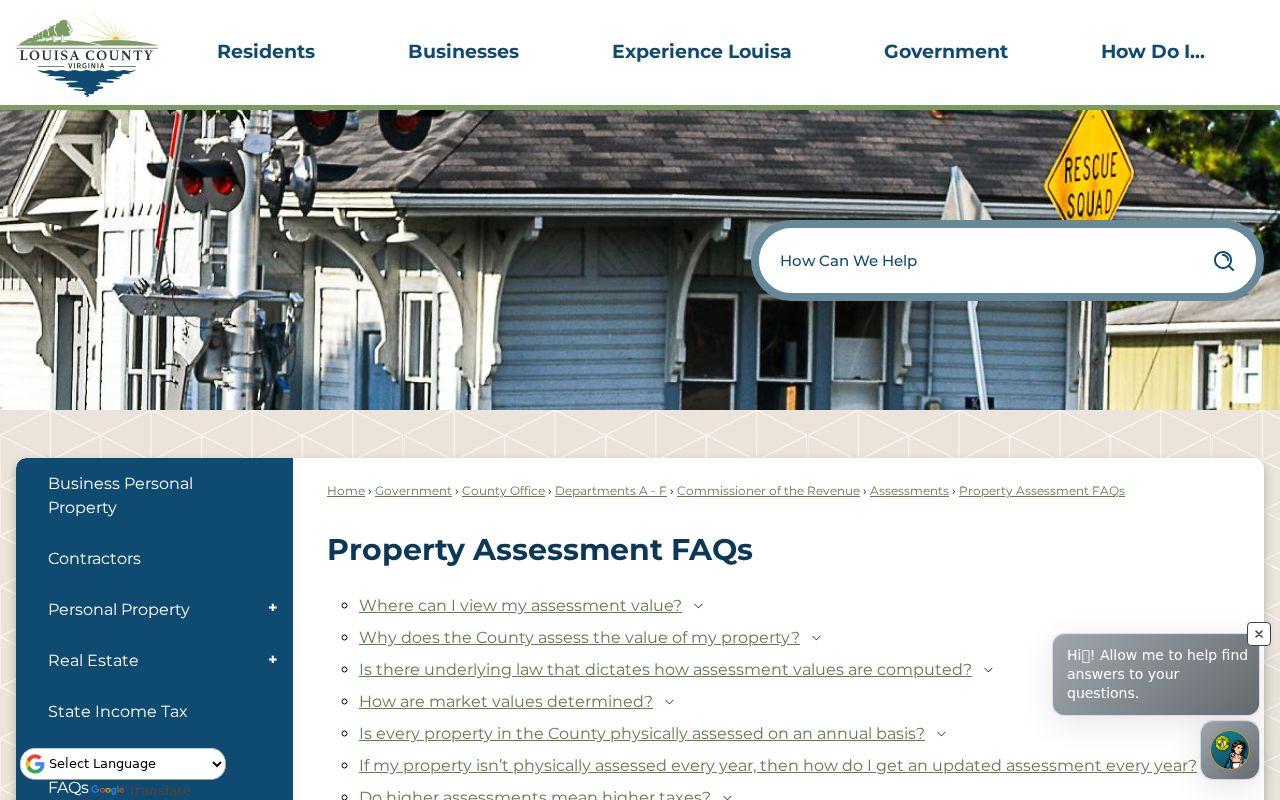
The county FAQ's worked examples put assessments side by side with actual sales, which makes clear why a ratio is a broad check rather than an individual appraisal of any one Louisa County property.
Look Up a Louisa Tax Bill
Have the bill’s Ticket Number and Property I.D. Number ready for the online payment screen. For payment questions, call the Treasurer at 540-967-3435; the office is at 1 Woolfolk Avenue, Suite 202. The county accepts payment online, by mail or at the counter, and offers payment plans by arrangement. A new owner who still has no bill by November 1 should contact the Treasurer rather than assume that a deed transfer automatically changed the billing address.
Use the bill identifiers to reach the payment account. If you are a new owner and no bill has arrived by November 1, the county directs you to contact the Treasurer. Keep the parcel address and tax bill nearby, since the assessment and tax account are separate sources.
- Find the Ticket Number and Property I.D. Number on the bill.
- Open the county Treasurer payment page and enter the required identifiers.
- Review the account status and any service charge before completing payment.
- For a mismatch or missing bill, contact the Treasurer at 540-967-3435.
Online payment carries a nominal service fee. The Treasurer also accepts payment in person or by mail. Louisa County tax payment instructions identify the account references and current deadlines, and payment plans may be arranged with the office.
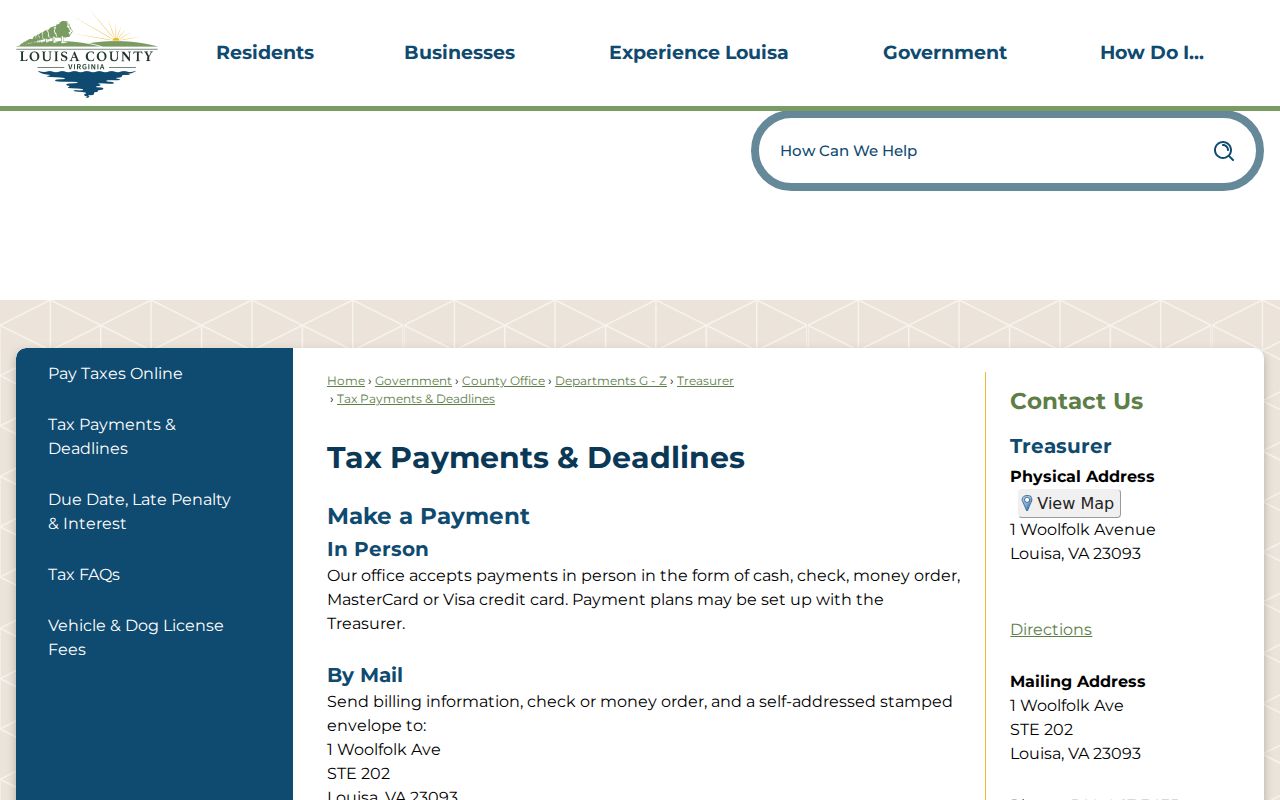
Keep the receipt with the bill. That way, any later payment question ties to the correct account.
Louisa County’s December Tax Date
Louisa real-estate taxes come due December 5. A ten percent penalty applies on December 6, the county states, and interest begins January 1. The Treasurer's page lists the online service charge, in-person and mail options, and office contacts. Confirm current payment details there before sending funds. The office sits at 1 Woolfolk Avenue, Suite 202, Louisa, VA 23093, open Monday through Friday from 8:30 a.m. to 5 p.m. Call 540-967-3435 with questions. Mail payments go to the office. The counter takes cash, check, money order, MasterCard or Visa. Payment plans may also be arranged. Delinquency notices should go straight to staff. The county publishes no parcel-by-parcel delinquency list, so never infer tax-sale status from a general payment page.
Appeals and Louisa Tax Relief
Virginia Tax’s 2024 study offers useful background for any assessment question. Louisa County reported 700 sales. The median assessment-to-sale ratio was 86.00 percent. The coefficient of dispersion was 16.75, and the regression index was 1.01. Those figures describe the county’s results across the study sample. They do not show that one parcel is assessed at exactly 86 percent of its market value. For an individual review, bring parcel-specific facts to the assessor. Bring comparable sales too, instead of applying the county statistic as a discount.
To frame an assessment review, identify the parcel. Compare the county’s property characteristics with the building, land and recorded changes you can document. Similar nearby sales can support a question. But sale price, assessed value and taxable bill are different measures. Ask the Commissioner of the Revenue at 540-967-3450 for the current appeal calendar and required submission route. The deadline follows the county’s published cycle, so do not infer it from the Treasurer’s December payment date.
Property owners who question an assessment should contact the Commissioner of the Revenue. Ask for the current review and Board of Equalization path, forms and filing dates. The county assessment page provides an appeal contact, but it publishes no step-by-step appeal calendar. Do not rely on a date from an older notice.
Before any assessment discussion, gather the parcel ID, the assessment record and any relevant property facts. The county explains that assessment weighs land and building characteristics and checks local sales ratios. Ask staff what evidence the current process accepts. Questions on an assessment go to 540-967-3450; owner-address or tax changes use 540-967-3432.
The county also posts tax-relief and exemption information. This includes relief for elderly or disabled owners. Get eligibility details and current application dates from the assessment office. Do not infer them from a short web summary.
Confirm the current calendar. Call the Louisa assessment office for the active appeal route and deadline before preparing a filing.
Keep Louisa Tax and Title Separate
A tax record is an administrative record, and its limits matter. The assessment owner name can lag a recent deed. Meanwhile the Treasurer may bill whatever owner or address the account carries. The Circuit Court clerk handles a different job. That office records deeds, deeds of trust, releases, easements, plats, liens, and probate instruments. Verify a transfer with the newest recorded conveyance. Then check how the parcel is listed for taxation on the assessment roll.
Keep two boundaries in mind. A tax bill is not proof of unencumbered title. A payment receipt is not proof of a property line. For a parcel lookup, the Louisa County property search route links assessment, GIS, and clerk records. A separate discussion of the numbers appears on the Louisa County property value page.
Finally, keep the deed book or instrument number beside the assessment parcel ID. That pairing lets the clerk and the assessment office answer their different questions. Neither system has to stand in for the other.
Payment Scams and Record Limits
Louisa County Planning and Zoning warns about spam solicitations. These imitate county project or fee requests. Verify any payment request using the number on the county's official contact page. A letter that names your property or a project is not automatically genuine. For a tax balance, the county Treasurer is the source. For recorded liens or deeds, the Circuit Court clerk is the source.
Virginia FOIA requests can reach county administrative records that are not online. Describe the record with reasonable specificity. Ask for a cost estimate. Say whether you want electronic inspection or a copy. Louisa charges based on the hourly rate of the lowest-paid staff member able to do the work. Advance payment is possible when expected costs exceed 200 dollars.
Official confirmation matters. A public tax page is not a title search, an appraisal or a delinquency list. Confirm a parcel record with the office that keeps it.