
Louisa County Property Value Types
Three figures often go by the name of a property value. The assessment is what the county taxes each year. Market value is the price a willing buyer and seller might reach in a given market. A last sale price is simply what one deed recorded for one transfer, shaped by its date and terms. All three can differ. None of them is necessarily wrong.
| Value type | What it means | Where it appears |
|---|---|---|
| Assessed value | County figure used for tax administration | Louisa assessment roll |
| Market value | Estimated price in an open market | Assessment method and market evidence |
| Last sale price | Consideration recorded for a transaction | Recorded deed and related index data |
Property records in Louisa County do not include a private appraisal. The public card may or may not break out land and improvement values, value history, sale history, or exemption flags. Trust the field labels on the live record rather than assuming a display.
Annual Value in Louisa County
Louisa County real estate carries a January 1 assessment date. Reassessment happens every year. State law requires assessments to reflect market value. The Commissioner of Revenue keeps each parcel record current, updates owner addresses and assessment changes for billing, and prepares the annual land book that the Treasurer relies on. Because of this cycle, any property value belongs to a specific assessment year.
The method has two moving parts. Annual analysis and sales-ratio checks run each year, while a physical review rotates through the county on a five-year cycle. Appraisers weigh square footage, home type, year built, quality, condition, bedroom and bath counts, acreage, and location. The FAQ also walks through ratio examples and the rotation schedule. The Louisa County assessment FAQ spells out the details.
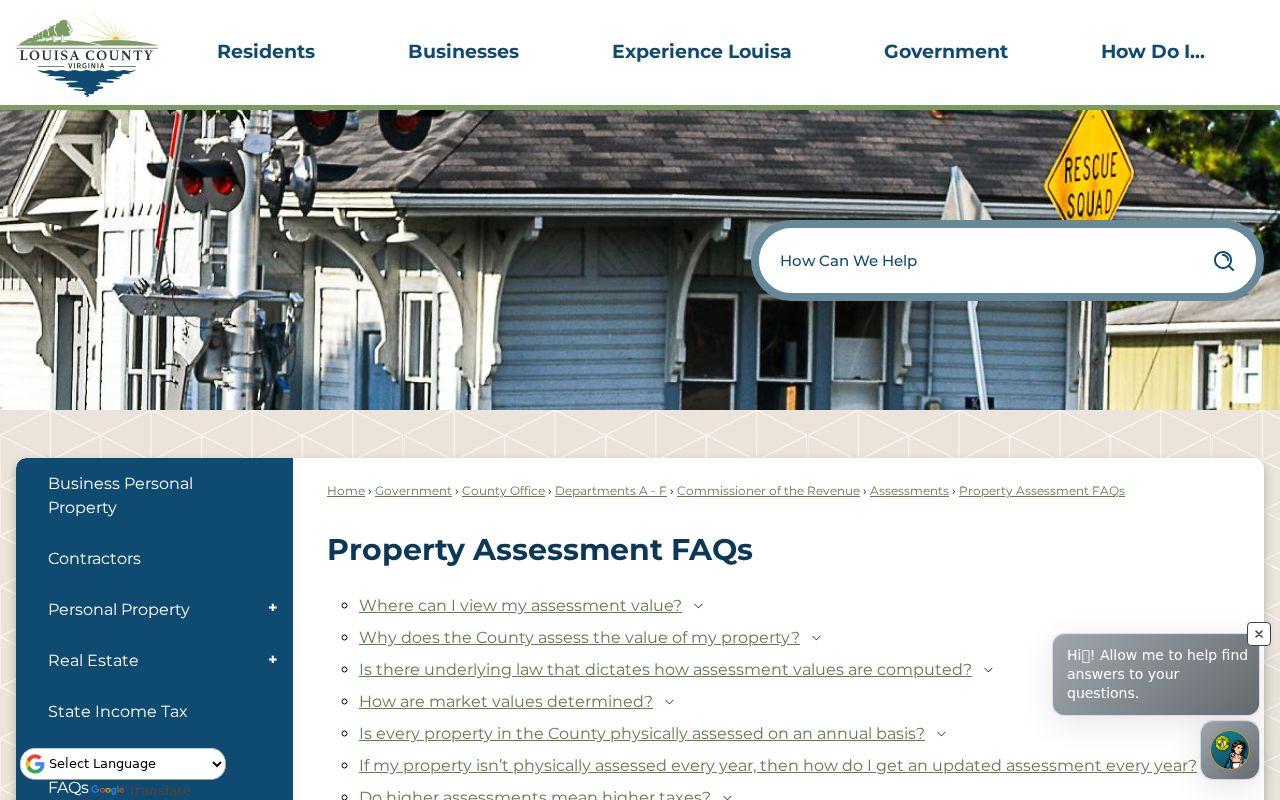
The FAQ explains how a countywide system estimates value across thousands of parcels at once, which is useful context before reading any single number.
Five-Year Physical Review Rotation
Louisa County's assessment FAQ describes a five-year physical rotation. The rotation sits inside a process that updates values annually. Read that carefully. It is not a fixed cap on market value. It also does not promise that a parcel's value will shift by the same amount each year. Staff also run sales-ratio checks, which compare assessment patterns against recorded sales across the locality.
Property traits shape the model too. The county lists square footage, property type, age, quality, condition, bedroom and bath count, acreage, and location as factors. When you pull up a parcel card, take only what the result actually displays. Ask the assessment office how a listed feature affects that parcel's value.
The assessment office answers value questions at 540-967-3450. Staff can explain the current method for a specific parcel. They can also say where that parcel sits in the review rotation.
Look Up a Louisa Property Value
Search the Louisa Assessments portal with a single detail. Try an owner name or a situs address. Combining details in one search causes problems, the county warns. Note the parcel ID and assessment year beside any value you record. Match your reading to the fields the result actually shows.
- Open Louisa Assessments and enter one address or owner detail.
- Choose the matching parcel and copy its map number.
- Record the value and year labels shown on the assessment card.
- Compare the current card with a deed or sale record only when the parcel and transfer match.
The Louisa Assessments portal is the county’s public owner and address search.
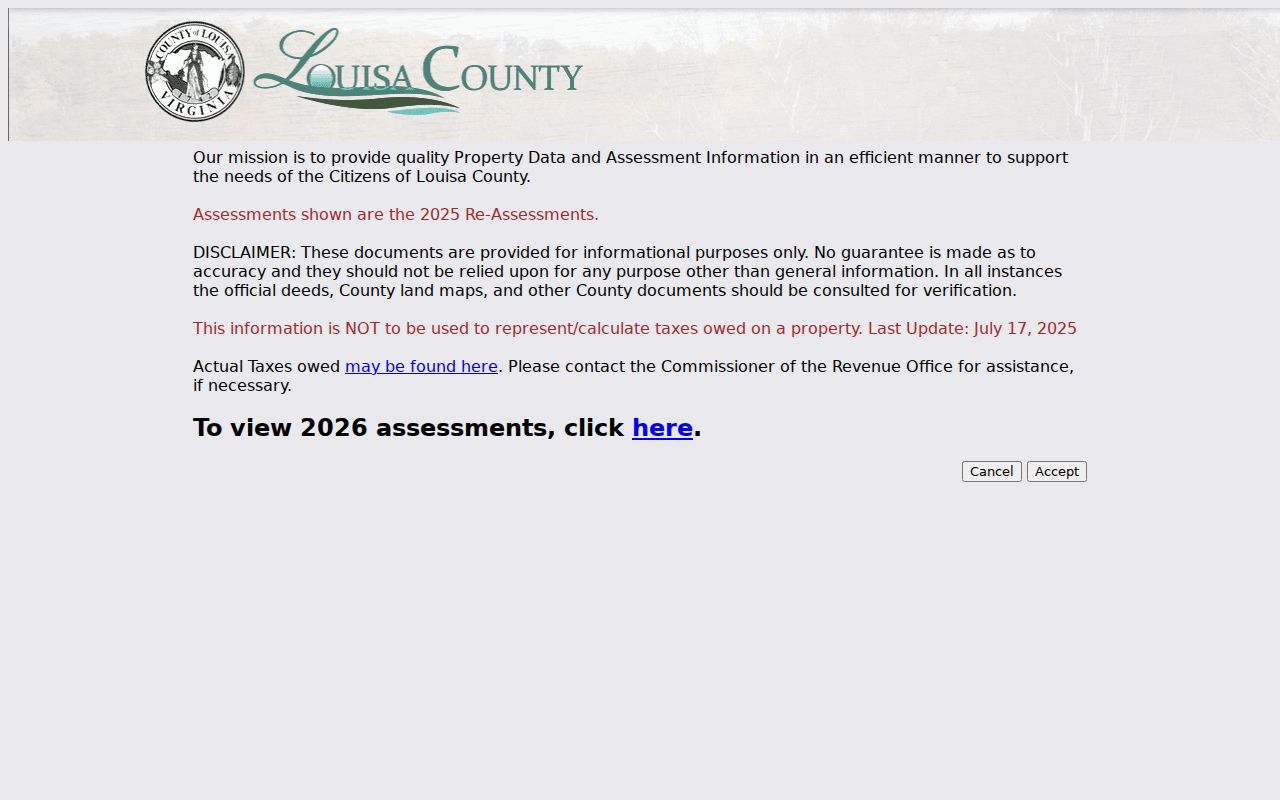
The landing page shows the public assessment search entry, not a parcel-specific value result.
Virginia’s Louisa Sales-Ratio Check
Virginia Tax's 2024 assessment-sales study covered 700 Louisa County sales. It reported a median assessment-to-sale ratio of 86.00 percent, a coefficient of dispersion of 16.75, and a regression index of 1.01. These are countywide quality measures for the study period, not a multiplier for one house. The median ratio compares assessments with observed sale prices. The dispersion describes how much those ratios vary. The regression index is a separate measure of trend. The Louisa row is part of the Virginia Tax locality study series.
A ratio below 100 percent means the median assessed level sat below the median sale price in the study sample. It is not a discount every parcel receives. Use the study to read the county's assessment climate. A parcel-level judgment still depends on condition, improvements, acreage, location, and assessment year, checked against comparable sales.
Recorded Sale Price and Assessment
A sale price and an assessment answer different questions. The price records one transfer between particular parties. An assessment, by contrast, is the county's administrative value for a stated assessment year. A deed index points to recorded transfers. Its public landing page does not confirm which sale fields display without a guest search. Before treating a sale as a value reference, compare the parties. Also compare the recording date, the legal description, and the parcel match.
For older sales, the deed image or a clerk copy may be needed. Cott eSearch serves as Louisa's land-record entry point. Virginia SRA may expose a free index where enabled. Images, however, require clerk authorization and a signed subscription. When a search result needs confirmation, the clerk can help.
A sale price also reflects the specific transaction. It should not be read as a current market appraisal. A value study likewise summarizes many sales and cannot replace a parcel-level analysis.
Assessment Value and Tax Bill
A tax bill is not the same thing as a value. It applies a rate adopted for a particular fiscal year to the taxable assessment. Relief or adjustments can change the final amount too. The assessor's value answers a valuation question, while the amount due answers a billing question. Keep the bill year beside any comparison. Verify the rate from the dated county notice. Louisa's 2025 notice, for example, described a 72-cent rate per 100 dollars and a 3.3 percent rebate on 2025 bills. Never carry those figures into another year unchecked.
The assessment value feeds tax administration. The bill itself is a separate account record. Its amount reflects the applicable rate plus any relief or rebate in effect that year. Exemption and relief details belong with the assessment office. The Treasurer handles payments. Payment dates, account identifiers, and relief questions appear in the Louisa County property tax records information. Keep valuation meaning apart from the balance.
A tax bill is not an appraisal. It does not prove clear title, an exact boundary, or a future sale price.
Limits of Louisa Property Values
A defensible comparison keeps location, sale date, acreage, improvements, condition, and land use in view. Waterfront parcels need a different lens. A Lake Anna waterfront parcel, a rural tract, and a small in-town lot are not interchangeable just because their tax-map areas sit close together. Each value comes from a different process. The county roll, for instance, is an annual administrative estimate. A recent sale is a transaction between particular parties. A commercial website's estimate is a model output. If the assessment looks inconsistent, take the parcel record and dated comparable evidence to the Commissioner of Revenue and ask about the current review steps.
An assessment is a mass-appraisal figure. It can differ from a later sale. Market conditions, property condition, improvements, and the transaction date all explain the gap. The online card may not show separate land and building subfields or a value history. Confirm those details in the live result.
- Assessment ratio
- A locality measure comparing assessed values with sale prices.
- Market value
- An estimate of an open-market price for a property.
- Sale price
- Consideration tied to a recorded transfer.
Assessment is not an appraisal. A Louisa County assessed value is used for tax administration and does not say what a property will sell for. Seek a qualified appraisal when a sale or lending decision needs one.
Start with the Louisa County property search to identify the parcel behind a value. Then carry that map number forward. It opens the assessment and deed systems tied to that same parcel.